
Australia, officially the Commonwealth of Australia, is a sovereign transcontinental country comprising the mainland of the Australian continent, the island of Tasmania, and numerous smaller islands. Australia is the largest country by area in Oceania and the world’s sixth-largest country. Australia is also the smallest continent and one of the largest countries on Earth, lying between the Pacific and Indian oceans in the Southern Hemisphere and its capital is Canberra.
Australia has a total area of about 7,692,024 KM2. Australia has a population of 23,401,892. This amount is based on census data in 2016 with a GDP per capita of around 53,825 United States Dollars. Around 70% of this country’s income is derived from the service sector, including tourism, education, financial services, and exports of agricultural and agricultural products, which are the second contributor to Australia’s economic activities.
The History of Australia
The history of the placement of the first humans on the Australian continent was recorded since 65,000 BC with evidence of the discovery of archaeological sites found in Animeland and the remains of lake mungo which are relics of the ancestors of the Aboriginal people, the modern Australian aborigines.
At first Australia had two names, namely Newland, the name given by Abel Tasman, a Dutch explorer in 1644 when he visited and mapped the island, and Terra Australis, the name taken from Latin, which means south island. The name was first used by Europeans when visiting and mapping it in the 17th century. Then the name Australia was popularized by explorer Matthew Flinders who considered that the name Australia was more suitable for the ears and assimilation of the names of other large parts of the earth.
At the end of the 18th century the British Empire occupied this continent and made it a dumping ground for criminals. Then in the 19th century a gold mine was discovered in Australia so that the Australian continent was crowded with immigrants. In 1824 Humilton Hume and former Royal Navy Captain William Hovel led an expedition in search of new grazing lands from the south of the colony.
In 1826 British claims were extended to the rest of the Australian continent when captain Edmund Lockyer established a settlement on King George Sound. Between 1855 and 1890, the 6 colonies individually acquired governments that were responsible for managing most of their own affairs while remaining part of the British empire. On January 1, 1901, the federation of the colonies was achieved and established the Commonwealth of Australia as the dominion of the British Empire. In 1914 Australia joined Britain in the battles of the First World War.
Australia participated in many of the major Battles that took place on the western front. In 1942 Australia received the Statute of Westminster from Britain along with Britain’s defeat in Asia and the threat of Japanese invasion causing Australia to turn to the United States as a new ally and protector. This treaty stipulates that an armed attack against one of the three parties will be harmful to the other and each party must act to meet the common threat.
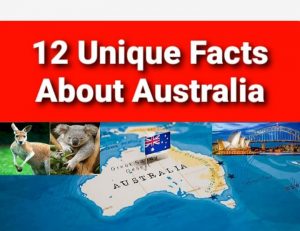
12 Unique Facts About Australia
1. Australia officially has six states namely Victoria, New South Wales, winsland, Western Australia and South Australia and Tasmania and two mainland territories, namely the Australian capital region and the northern territories.
2. Australia is a member of the Commonwealth of the British Empire, which makes Queen Elizabeth 2 the queen of Australia. The country with the capital city of Canberra is the largest country in Oceania and the sixth largest country in the world by area
2. The currency of this country is the Australian Dollar with a GDP per capita of around 53,825 United States Dollars, Australia is ranked the 14th largest economy in the world with a comparison of area and population, the population density level in Australia is around three people per km2 and although it is an indigenous tribe from Australia, from Aboriginal tribes only about 3.1% of the total population of Australia
4. Australia was claimed by Europeans as a convict colony because the first Fleet to land in Australia were half of the convicts. The history of police in Australia is quite unique. The first police in the country of kangaroos were well-behaved convicts.
5. EMU War is a military operation launched at the end of 1932, the military operation aims to reduce the number of EMU. The EMU is a large flightless bird native to Australia whose numbers at that time were so excessive in the Champion district of Western Australia the soldiers who participated were armed with Louis rifles that the Australian media dubbed this operation the MU war, but this operation failed to achieve its goal. The beginning of the EMU’s role was after the first world war many Veterans from Australia and some British Veterans were farming wheat in Western Australia but they faced difficulties due to the arrival of around 20,000 EMU. The EMUs eat and destroy crops and leave large holes in fences, disturbing many farmers.
6. There are 3 species of kangaroos in Australia, namely the eastern gray red kangaroo and the western gray kangaroo. The red kangaroo is the largest living marsupial, standing up to more than two meters in height and weighing up to about 90 kg. This type of kangaroo usually moves in large groups. While the Western and Eastern kangaroos are usually found in the western and eastern parts of Australia.
7. Popularly known as boomerang a boomerang is a thrown device that is designed to rotate on an axis perpendicular to the direction of its flight. The Revolving Boomerang is designed to return to the direction of the thrower it is known as the weapon with which some Aboriginal Australians hunt.
8. The Tasmanian Devil is one of Australia’s endemic animals on the island of Tasmania. The Tasmanian Devil is one of the typical marsupials from Australia and is the largest carnivorous marsupial animal today after the extinction of the Tasmanian tiger in the 20th century, the marsupial animal itself is a type of mammal with the characteristic of having a pouch on the female and spread between Australia, Papua New Guinea, some in Papua and America among the famous marsupials are kangaroos and koalas.
9. Tasmania is one of the places that provides the cleanest water and air in the world. Tasmania also has very pure water so there is bottled rainwater that can be consumed and approved by the Department of Health worldwide in Tasmania also unlike other mainland Australian states because Tasmania has four seasons so you can swim in the summer and make a snowman in the summer. winter.
10. Only about twenty-five percent of the species from the biodiversity of Australia have been identified, there are still many species that inhabit the continent that have not been identified. Australia is home to one of the world’s deadliest marine animals, the box jellyfish. This animal is one of the most venomous sea creatures in the world.
The sting of this species is very painful and sometimes fatal to humans. Even the sting of some species of box jellyfish or often called Irukandji jellyfish can cause Irukandji syndrome. Irukandji syndrome is a condition caused by the entry of venom by a jellyfish sting, this condition is rarely fatal, but if medical action is not taken immediately, in just 20 minutes the victim can have a heart attack and die.
11. Australia is the only continent in the world that does not have an active volcano. The Great Barrier Reef is home to the largest coral reef ecosystem in the world. The great Victoria desert is the largest desert in Australia. This desert is located in Western Australia and South Australia this desert has a width of more than 800 KM and covers an area of 348,750 km2.
12. Australia being the country’s largest wool producer, this country produces around 400 thousand tons of wool or can meet one-fifth of the world’s wall needs. Behind all that, Australia is famous for its large population of sheep, the number of which can reach approximately 100 million heads.
That’s a little summary of the history and unique facts about the country of Australia. Hopefully it can provide a little benefit for all of us.
